GROWTH STRATEGY

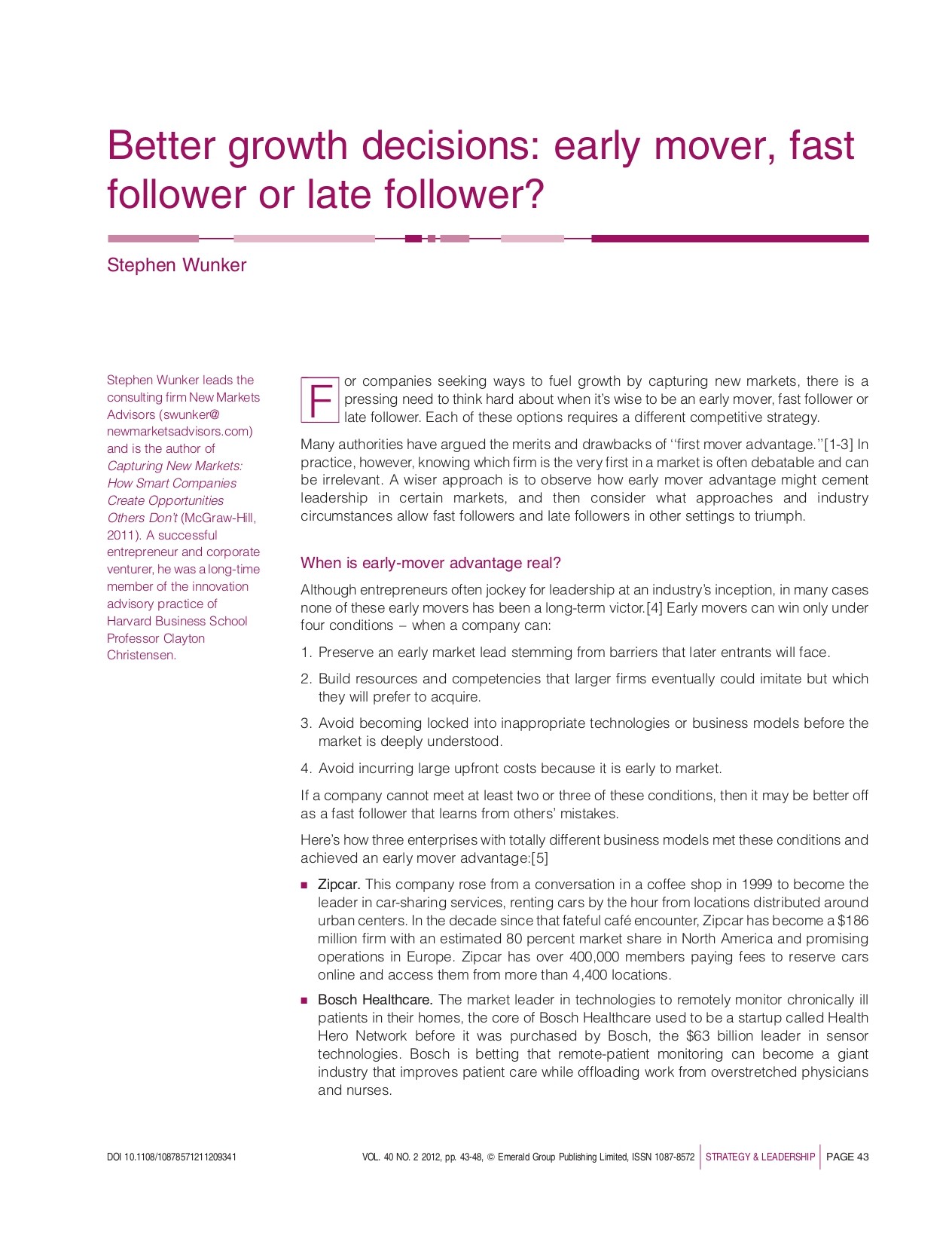
Fast Follower vs First Mover: How to Choose the Right Growth Strategy for New Markets

Executive Takeaway: Timing is not a badge of honor. It is a strategic choice

The right market-entry strategy depends less on whether you are first and more on whether your capabilities and market conditions make early entry, fast following, or late-mover positioning defensible and durable.

The idea of first-mover advantage has guided and, in many cases, misled how companies make growth decisions. Executives feel pressure to move early, plant a flag, and establish category ownership before competitors arrive. The instinct is understandable but costly if applied without deep understanding.

The company that arrives first often bears the highest costs: educating the market, absorbing technical failures, attracting skeptical early customers, and building infrastructure without knowing what the market will ultimately reward. Many early movers do not survive long enough to enjoy their pioneering status.

This is not to say that first-mover advantage is a myth. It means that early entry creates durable advantage only under specific conditions. Fast follower strategy and late-mover strategy can each produce dominant market positions when applied under the circumstances.

The better question is not "can we be first?" but rather: "Given our capabilities and the structure of this market, what does entry timing allow us to do that arriving earlier or later would not?"

When Early-Mover Advantage Is Actually Real

Early-mover advantage is real, but only under four conditions. Companies that rush to market without satisfying at least 2 of them are involuntary market educators, paying the costs of category creation so that better-positioned followers harvest the returns.

Before committing to early-entry timing, executives should ask whether their organization can meet at least two or three of these conditions. If a company cannot meet at least two or three of these conditions, early entry may be more dangerous than valuable.

  1. Raise barriers to later entrants

Can the company establish a position that later competitors will find genuinely difficult — not just expensive — to replicate? This could mean owning physical infrastructure, accumulating network effects, building brand association with the category itself, or developing intellectual property that cannot simply be invented around.

  1. Build capabilities that are easier to acquire than to imitate

The early mover that develops a set of competencies, relationships, or proprietary assets that a larger competitor would rationally prefer to buy rather than build has created an exit strategy as well as a competitive moat. This is a distinct and under-appreciated form of early-mover value.

  1. Avoid lock-in to the wrong technology or business model

One of the subtler hazards of early entry is committing deeply before the market has revealed its true preferences. Companies that pilot carefully and treat early signals as hypotheses rather than facts are far more likely to survive the inevitable course corrections.

4. Keep upfront costs proportionate to the potential reward

One of the subtler hazards of early entry is committing deeply before the market has revealed its true preferences. Companies that pilot carefully and treat early signals as hypotheses rather than facts are far more likely to survive the inevitable course corrections.

What Successful Early Movers Do Differently

Three companies with dramatically different business models illustrate how these conditions play out in practice.

Case 1: Zipcar

Zipcar built more than a car-rental service — it built a category. By establishing density of locations before competitors could, it locked up both consumer mindset and urban infrastructure. When Hertz launched Connect by Hertz, it faced the economics of building location density before having members, against a brand that customers already trusted. Zipcar had not simply moved early; it had made catching up structurally difficult.

Boutique consulting vs Large consulting firm hierarchical organizational structure

Case 2: Bosch Healthcare

Bosch Healthcare (originally Health Hero Network) accumulated 63 patents, completed clinical studies, and embedded its technology into hospital workflows years before GE and Intel entered remote patient monitoring. When those better-capitalized competitors arrived, they found themselves competing against advantages that were neither quickly copied nor cheaply replicated. Bosch's acquisition of Health Hero was rational precisely because the startup had become faster to buy than to rebuild.

Case 3: The Wiggles

The Wiggles built not just a music act but an ecosystem — TV show, character franchises, merchandising — that surrounded and protected their core. When a critic called a competitor's album "the best kids' record ever," The Wiggles' position remained undisturbed. Their moat was not the music. It was everything around it.

Boutique consulting vs Large consulting firm hierarchical organizational structure

Resources

Your Business Model Shapes the Right Entry Timing

One of the most useful dimensions of market-entry strategy is that different business model structures reward different entry timing. There is no universal answer to "should we be first?" because the answer depends heavily on the kind of business you are building.

The right consulting model depends on the nature of the challenge.

The comparison below outlines when organizations typically benefit most from a boutique consulting firm versus a large consulting firm.

Solution Shops

Niche professional services, customized software, specialized instruments — compete on reputation and bespoke expertise. Early movers can build reputational advantages that accumulate over time. But if an industry is heading toward standardization rather than remaining customized, early leadership in the solution-shop phase may not translate forward. The Altair 8800 was the first personal computer. Its customers were hobbyists who valued technical challenge — very different from the mainstream buyers who came next and defined the market.

Value-Chain Businesses

Automakers, consumer goods companies, distribution-intensive industries — reward efficiency, market power, and ecosystem access above all. Here, being first is not necessary. What matters is being among the first to build a solid ecosystem. IBM was not a pioneer in personal computing. It used its leverage with suppliers, developers, and resellers to create the industry-standard ecosystem — and that, not chronological priority, created dominance.

Facilitated-Network Businesses

Platforms whose value derives directly from network size — reward early positioning most acutely. In network businesses, a firm need not be first, but it must establish a strong position before the network's growth inflects. After that point, displacement becomes exponentially harder. Visa's dominance in credit cards and Facebook's in social media are both expressions of this same structural reality.

Insight 💡

The business model is not just a descriptor — it is a diagnostic tool. Before deciding when to enter a new market, executives should determine whether their category will behave as a solution shop, a value-chain business, or a facilitated network. Each one rewards different timing and different competitive moves.

When Fast Follower Strategy Outperforms First Mover

There is a structural case for the fast follower that growth strategies rarely acknowledge. In many markets, the first company in absorbs the most uncertain costs — market education, technology experimentation, the inevitable dead ends of category creation.


The fast follower who enters once those costs have been sunk and the market has revealed its preferences can often move with greater efficiency and precision.

Fast following works best when pioneers have absorbed heavy upfront costs, when the follower holds superior sales capabilities or channel relationships, or when open innovation networks provide early access to promising ideas without the full risk of pioneering them.


In satellite communications, early ventures like Iridium built expensive infrastructure to serve small markets. Later entrants like O3B deployed lower-cost technology into markets where demand had since grown substantially. The fast followers did not lose by being later. They gained by being selective.

Today, competitive advantage is increasingly shaped by how well organizations frame their most important problems.

Markets are shifting faster. AI is reshaping industries. Customer expectations evolve rapidly. In this environment, breakthrough advantage rarely comes from scale alone — it comes from sharper insight.

The companies that outperform are often those that:

  • Frame the right strategic question

  • Identify overlooked growth opportunities

  • Connect weak signals into coherent direction

  • Move decisively before competitors

These capabilities depend on experienced strategists who can navigate ambiguity and synthesize complexity — not just deploy large teams.

As strategy becomes more conceptual and less procedural, the structural advantages of boutique consulting firms become more relevant.

For executive teams making high-impact decisions about growth, innovation, and transformation, depth of thinking can matter more than organizational scale.

Insight 💡

Fast following is not timidity. It is the discipline to hold back until the market has revealed its structure — and then to move with more precision than any pioneer could have managed.

One critical caveat: many companies that believe they are playing a fast-follower strategy are simply slow movers, arriving after the competitive order has solidified. That is not fast following. That is being late.

Today, competitive advantage is increasingly shaped by how well organizations frame their most important problems.

Markets are shifting faster. AI is reshaping industries. Customer expectations evolve rapidly. In this environment, breakthrough advantage rarely comes from scale alone — it comes from sharper insight.

The companies that outperform are often those that:

  • Frame the right strategic question

  • Identify overlooked growth opportunities

  • Connect weak signals into coherent direction

  • Move decisively before competitors

These capabilities depend on experienced strategists who can navigate ambiguity and synthesize complexity — not just deploy large teams.

As strategy becomes more conceptual and less procedural, the structural advantages of boutique consulting firms become more relevant.

For executive teams making high-impact decisions about growth, innovation, and transformation, depth of thinking can matter more than organizational scale.

Better growth decisions: early mover, fast

follower or late follower?

working paper

This framework helps leaders choose the right market entry strategy based on real competitive conditions:

Understand when early movers can build lasting advantage—and when they cannot

Learn how fast followers and late entrants win through selectivity, timing, and execution

When Late Movers Can Still Win

Some of the most consequential market entrants were not early at all. Samsung and LG entered mobile phones well after Nokia and Ericsson had established leadership — and became global giants. Apple entered later still and captured over 30 percent of industry profits.

The right consulting model depends on the nature of the challenge.

The comparison below outlines when organizations typically benefit most from a boutique consulting firm versus a large consulting firm.

Exploiting missteps

Samsung and LG flourished when market leaders allowed handset designs to stagnate. They mastered rapid design cycles and built a position incumbents were organizationally ill-suited to contest. By mastering rapid design cycles and bringing fashionable devices to market quickly, they built a position that the incumbents were organizationally ill-suited to contest.

Leveraging channels

Distribution is often a more durable competitive advantage than product. Samsung and LG recognized that cellular carriers control which handsets consumers consider — and they offered carrier partners compelling terms to earn prominent placement in lineups. A late entrant with superior channel relationships or an ability to structure partnerships creatively can overcome a significant product or brand disadvantage.

Use Adjacent Capabilities and Networks

Both Samsung and LG had large-scale businesses in display technology and other phone components. That position gave them an unusual advantage: they could enter discussions about integrating new display innovations very early in handset design cycles, and arrive at market first with the most compelling screen technology of each generation. Being a late mover in the phone industry, they were simultaneously an early mover in the specific technical capabilities that would define it.

Redefine the Category

Apple is the definitive case. By the time the iPhone launched, the cell phone market appeared mature. Apple did not enter it as defined — it entered a different market, the mobile internet, that happened to subsume it. The iPhone was not primarily a phone; it was a networked computing platform with voice capability. By reframing the category, Apple rendered years of incumbent investment in phone-market positioning largely irrelevant. Companies that can identify a more fundamental problem and built around that, can arrive late and win comprehensively.

A Practical Framework for Choosing Entry Timing

The decision between early mover, fast follower, and late-mover strategy is not a matter of temperament or appetite for risk. It is a diagnostic question, answerable with a structured analysis of market conditions and organizational capabilities.


Before committing to any entry timing, executives should work through three questions:

The right consulting model depends on the nature of the challenge.

The comparison below outlines when organizations typically benefit most from a boutique consulting firm versus a large consulting firm.

Can we build barriers that hold?

If network effects, infrastructure, IP, or brand association can be established in the early period, early entry is worth its costs. If not, the pioneer's investment may simply subsidize the follower.

Leveraging channels

Distribution is often a more durable competitive advantage than product. Samsung and LG recognized that cellular carriers control which handsets consumers consider — and they offered carrier partners compelling terms to earn prominent placement in lineups. A late entrant with superior channel relationships or an ability to structure partnerships creatively can overcome a significant product or brand disadvantage.

Do we have the capabilities that the timing requires?

Fast following demands strong distribution and sales execution. Late entry demands either exploitable vulnerabilities in the incumbent or a genuine ability to reframe the category. Entry timing strategy must match organizational reality, not aspiration.

What kind of business are we building?

Solution shops, value-chain businesses, and facilitated networks each reward different timing. Diagnosing the business model is the first step in diagnosing the right moment to enter.

Early Mover vs Fast Follower vs Late Mover: A Comparison

The three entry strategies carry distinct risk-reward profiles, best-fit conditions, and sources of competitive advantage. No single approach is universally superior.

The right consulting model depends on the nature of the challenge.

The comparison below outlines when organizations typically benefit most from a boutique consulting firm versus a large consulting firm.

Strategy Best When Primary Risk Advantage Source
Early Mover Network effects matter; barriers can be built; lock-in risk is manageable Bearing market-creation costs; committing to the wrong model early Category ownership, infrastructure, IP, switching costs
Fast Follower Pioneers absorb upfront costs; you have superior channels or sales capability Moving too slowly and becoming simply a late entrant Efficiency, selectivity, open innovation, distribution power
Late Mover Incumbents are vulnerable; you can redefine the category or leverage adjacencies Entering a mature market without a differentiated angle Exploiting missteps, channel leverage, category redefinition

Frequently Asked Questions

What is the difference between a first mover and a fast follower?

A first mover (or early mover) enters a new market before competitors, bearing the costs and risks of establishing the category. A fast follower enters soon after pioneers, learning from their mistakes while the competitive order is still being determined. The distinction is not purely chronological — it is strategic. First movers aim to build durable advantages through early positioning; fast followers aim to enter with greater precision and efficiency once the market's structure is clearer. New Markets Advisors has worked with global organizations across North America, Europe, and other international markets, advising senior leadership teams on high-impact strategic decisions.

When does first-mover advantage actually matter?

Can late movers still become market leaders?

What is a fast follower strategy?

How do you choose the right market-entry strategy?

What is the difference between a first mover and a fast follower?

A first mover (or early mover) enters a new market before competitors, bearing the costs and risks of establishing the category. A fast follower enters soon after pioneers, learning from their mistakes while the competitive order is still being determined. The distinction is not purely chronological — it is strategic. First movers aim to build durable advantages through early positioning; fast followers aim to enter with greater precision and efficiency once the market's structure is clearer. New Markets Advisors has worked with global organizations across North America, Europe, and other international markets, advising senior leadership teams on high-impact strategic decisions.

When does first-mover advantage actually matter?

Can late movers still become market leaders?

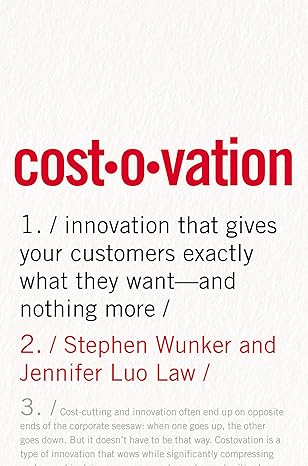
Costovation - Discover How To Build Low-Cost Business That Customer Love

How do you choose the right market-entry strategy?

Connect With Us

Let's Talk

Fill out the form below to start the conversation about working with New Markets Advisors

Connect With Us

Let's Embrace AI Together​

Fill out the form below to start the conversation about working with New Markets Advisors

Executive Takeaway: Timing is not a badge of honor. It is a strategic choice

The right market-entry strategy depends less on whether you are first and more on whether your capabilities and market conditions make early entry, fast following, or late-mover positioning defensible and durable.

Our Offices

50 Franklin St

2nd Floor

Boston, MA 02110

USA

151 San Francisco St

Suite 200

San Juan, PR 00901 Puerto Rico

Rua Antónia Andrade 4

3 Direito

1170-025 Lisboa

Portugal

Privacy Policy

Terms of Service

New Markets Advisors © 2025 

Our Offices

50 Franklin St

2nd Floor

Boston, MA 02110

USA

151 San Francisco St

Suite 200

San Juan, PR 00901 Puerto Rico

Rua Antónia Andrade 4

3 Direito

1170-025 Lisboa

Portugal

Privacy Policy

Terms of Service

New Markets Advisors © 2025 

Our Offices

50 Franklin St

2nd Floor

Boston, MA 02110

USA

151 San Francisco St

Suite 200

San Juan, PR 00901 Puerto Rico

Rua Antónia Andrade 4

3 Direito

1170-025 Lisboa

Portugal

Privacy Policy

Terms of Service

New Markets Advisors © 2025 

Privacy Policy

Terms of Service

New Markets Advisors © 2025 

Our Offices

50 Franklin St

2nd Floor

Boston, MA 02110 USA

151 San Francisco St

Suite 200

San Juan, PR 00901 Puerto Rico

Rua Antónia Andrade 4

3 Direito

1170-025 Lisboa

Portugal

Get In Touch

+1 617 936 4035

info@newmarketsadvisors.com